Mast-EER Cohort
Training the next generation of Engineering Ecosystem Resilience scholars
Mast-EER is a pioneering Masters by Research (MbyRes) cohort funded by the Advanced Research + Invention Agency (ARIA) through its Engineering Ecosystem Resilience (EER) opportunity space.
This MbyRes cohort develops a pool of interdisciplinary researchers who are comfortable working at the edge of what is currently possible, challenging assumptions, and tackling complex problems where the answers are far from obvious in order to bring about a step-change for ecosystem resilience.
A pilot for ARIA, Mast-EER is the first time the funding agency has supported a Master’s programme of any kind in recognition of the need to develop the next generation of researchers to advance this space.
The funding will cover home tuition fees, a generous research and training support grant and a programme of cohort activities designed to foster interdisciplinary research, collaboration and innovation. The students will be based within the University’s Centre for Ecology and Conservation (CEC) in Penryn.
Engineering Ecosystem Resilience is one of the most ambitious scientific challenges of our time.
Ecosystems provide essential services that underpin human wellbeing and economic prosperity, serving as critical natural infrastructure that supports food systems, climate stability, biodiversity and the sustainable provision of natural resources. Yet our ability to understand, predict and influence how these complex living systems respond to environmental change remains limited.
Mast-EER was created in response to this challenge. Inspired by ARIA's Opportunity Seed philosophy, the cohort supports multiple exploratory research projects simultaneously, creating opportunities to investigate bold ideas, challenge assumptions and identify new directions for research and innovation.
Students will be encouraged to work at the edge of what is currently possible, pursuing projects that are ambitious, interdisciplinary and potentially transformative
We are looking for curious, ambitious and intellectually adventurous researchers who are excited by complex challenges and comfortable working across disciplinary boundaries.
Engineering Ecosystem Resilience is not a problem that can be solved by ecology alone, nor by engineering, data science, genomics, artificial intelligence or environmental modelling in isolation. We therefore welcome applications from talented graduates with backgrounds spanning the natural sciences, engineering, mathematics, computer science, data science, environmental sciences, geography, social sciences and related disciplines.
Successful applicants will be people who:
- enjoy tackling difficult questions where the answers are not yet known;
- are willing to challenge assumptions and explore unconventional ideas;
- are excited by interdisciplinary research and collaboration;
- are motivated by the potential to generate real-world impact;
- are comfortable navigating uncertainty and complexity;
- are eager to contribute to a supportive and intellectually diverse research community.
You do not need to have prior expertise in Engineering Ecosystem Resilience. What matters most is your curiosity, creativity, and enthusiasm for exploring ambitious ideas that could help shape the future of ecosystem resilience.
If you are excited by the prospect of working at the intersection of disciplines, contributing to a pioneering ARIA-funded cohort, and exploring questions that are 'big if true', we encourage you to apply.
Students will join a community of researchers exploring diverse aspects of ecosystem resilience.
Current areas of interest include:
Ecosystem prediction and modelling
- AI-enabled ecosystem forecasting
- Social-ecological networks
- Community stability and resilience
- Predictive ecological modelling
Genomics, adaptation and evolutionary resilience
- Assisted adaptation to environmental change
- Precision genomics for conservation
- Experimental evolution
- Microbiome and holobiont engineering
Biodiversity, restoration and recovery
- Pollinator resilience
- Species reintroductions
- Habitat connectivity
- Rainforest and coral reef restoration
Ecosystem health and emerging threats
- Pathogen emergence
- Antimicrobial resistance
- Wildlife disease ecology
- Climate-driven ecological change
Technology-enabled ecosystem interventions
- Environmental sensing
- AI-assisted ecological monitoring
- Robotics and automated environmental management
- Novel approaches to ecosystem engineering
These themes are illustrative rather than prescriptive. Students will work with supervisors and the wider cohort to develop projects aligned with ARIA's Engineering Ecosystem Resilience opportunity space.
Our Mast-EER Booklet illustrates the kinds of ambitious, interdisciplinary projects that could be developed within the Mast-EER programme. Projects will be refined collaboratively between students and supervisors and may evolve as the Engineering Ecosystem Resilience opportunity space develops.
Students will benefit from:
- Full home tuition fee support
- Research and training support funding
- Cross-disciplinary supervision
- Specialist workshops and cohort events
- Professional development opportunities
- Engagement with academic, industry, policy and entrepreneurial communities
- Access to Exeter's internationally recognised research environment
Students will join a thriving postgraduate research community within the Centre for Ecology and Conservation and benefit from interactions across the wider University of Exeter research ecosystem.
Dr M.D. Sharma
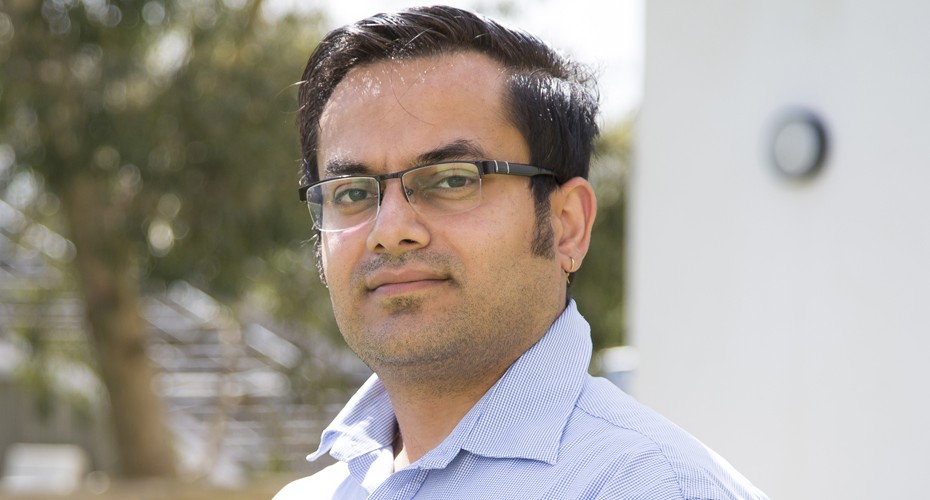
What attracted us to ARIA's Engineering Ecosystem Resilience opportunity space was the recognition that no single discipline, methodology or research project is going to provide all the answers. The challenge demands a diversity of perspectives and approaches.
Dr Erik Postma

Rather than exploring a single idea in a single study system, "Mast-EER" adopts ARIA’s ‘Opportunity Seed philosophy’ to create a cohort of 20 talented researchers to investigate many different aspects of ecosystem resilience in parallel; 20 interconnected pieces of the puzzle. The result is a highly cost-effective way to explore ambitious, 'big if true' questions, generate new scientific insights, and identify promising directions for future research and innovation.”
Urgent, hard problems aren't solved by well-established approaches. Humanity-scale challenges need people who think outside the box. We're backing early-career researchers who combine a deep understanding of the complexity of ecological systems with fluency in biotechnology, robotics and AI.
Supporting communities of responsible innovators who have an authentic ambition to redefine our relationship with nature is precisely the kind of bet ARIA wants to be making.
Yannick Wurm
Programme Director at ARIA